9 Questions Most People Forget to Ask Before Ordering Modular Furniture
Most furniture decisions go wrong before the first piece is installed. Not because of the design, not because of the budget, but because the right questions were never asked. Modular furniture manufacturers in Mumbai range widely in quality, process, and honesty — and the only way to tell the difference is to ask questions that expose how they actually work.
Here are the ones worth asking. In order of how often they’re skipped.
What Exactly Is the Core Material?
This is the question that separates serious buyers from impulsive ones. The visible finish — laminate, acrylic, membrane, veneer — gets most of the attention. The core material that everything is built on gets almost none.
BWR-grade plywood (Boiling Water Resistant) is the standard to ask for in Mumbai’s humid conditions. HDF (High Density Fibreboard) is a middle-ground option used for shutters and back panels. MDF is cheaper and more prone to swelling near moisture. Particle board is at the bottom of the durability scale.
Any credible modular furniture manufacturer in Mumbai will tell you exactly which core material they’re using without hesitation. If the answer is vague — “good quality board” or “premium material” — push harder. The core material directly determines how long your furniture lasts.
What Brand of Hardware Goes Into the Build?
Hardware is the part of modular furniture you interact with dozens of times every day: hinges, drawer channels, lift mechanisms, handles. It’s also the part that fails first when quality is compromised.
Hettich, Blum, and Hafele are the three hardware brands that consistently appear in quality modular furniture builds in Mumbai. They’re German-engineered, widely available, and carry warranties of their own. A quote with Blum soft-close hinges will cost more than one with generic hardware — the difference is real and it’s worth paying.
Ask specifically. “Which hardware brand do you use?” is a fair question, and the answer tells you a lot about how a manufacturer thinks about longevity vs. margin.
Do You Visit the Site Before Finalising the Design?
This sounds obvious. You’d be surprised how many manufacturers skip it.
A site visit before finalising measurements isn’t optional for good modular furniture work — it’s essential. Walls aren’t always plumb. Floors aren’t always level. The beam that doesn’t appear on the floor plan will definitely appear when the wardrobe frame arrives. Modular furniture manufacturers in Mumbai who take accurate site measurements before production save everyone a great deal of grief on installation day.
If a manufacturer is quoting you entirely from phone photos or a WhatsApp conversation without visiting the site, that’s worth noting.
What Does the Warranty Actually Cover?
Warranties in the furniture industry are often narrower than they sound. “Lifetime warranty on the frame” can mean the bare plywood structure — not the finish, not the hardware, not the hinges. A finish warranty of 5 years is a reasonable standard. Hardware warranties vary by brand.
Ask for the warranty terms in writing. Not a verbal assurance. A written document that specifies what’s covered, for how long, and what the process is if something fails. Reputable modular furniture manufacturers will have this ready.
How Long Will Installation Actually Take?
The gap between “estimated installation: 3 days” and the reality of 10 days with gaps in between is a common source of frustration for Mumbai homeowners. Ask for a production timeline, a delivery date, and an installation duration — separately.
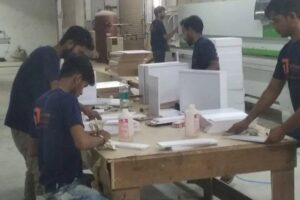
Also ask whether installation is done by in-house carpenters or contracted labour. In-house teams tend to be more accountable. Contracted labour on a per-job basis can be inconsistent.
What Happens If Something Is Damaged During Installation?
It happens. A laminate edge chips on the way up the stairs. A shutter arrives with a production defect. A handle is missing from the package.
A clear answer here sounds like: “Any damage during installation is our responsibility and we replace or fix it at no cost.” A vague answer, or one that asks you to “check and let us know within 24 hours,” is a signal to clarify the terms before you sign.
Can I See a Completed Project Similar to Mine?
References matter more than showrooms. A showroom is a controlled environment with ideal lighting and unlimited budget. A completed project in a 2BHK in Thane or a 1BHK in Andheri is a real-world result you can actually evaluate.
Most honest modular furniture manufacturers in Mumbai are happy to share photos of completed work or even arrange a visit to a previous client’s home (with consent). If a manufacturer hesitates at this request, it’s worth asking why.
What's Not Included in This Quote?
Civil work, electrical points for internal lighting, paint touch-ups after installation — these sometimes fall into a grey zone between the furniture manufacturer and the contractor. Get absolute clarity on what the furniture manufacturer is responsible for and what they’re not.
“Scope of work” clarity avoids the kind of post-installation disputes that turn a good project into a bad memory.
Is There a Post-Installation Support Process?
A wardrobe hinge that loosens after eight months. A kitchen drawer that comes off its channel. These aren’t failures — they’re normal maintenance events. The question is whether your manufacturer will respond when you call.
Ask directly: “What’s your process for post-installation support?” A manufacturer who has thought about this will have a straight answer. One who hasn’t will fumble.